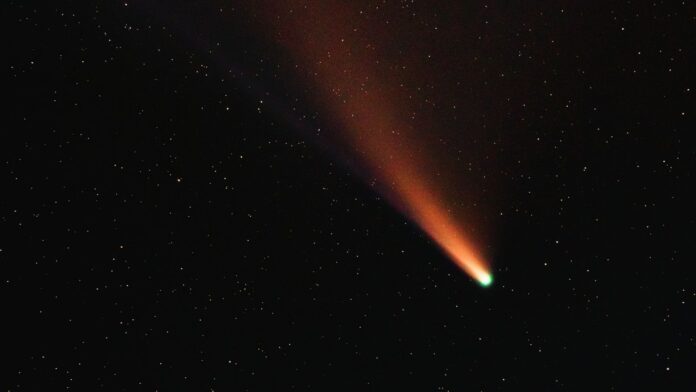

A rare astronomical event is currently unfolding as a sungrazing comet makes its perilous approach toward the sun, entering a phase that scientists describe as both critical and unpredictable. The comet, identified in recent observational cycles, is now nearing perihelion—the closest point in its orbit to the sun—where extreme solar forces will determine its fate.
Astronomers across the world are closely monitoring this event in real time, as such close solar encounters are relatively uncommon and often result in dramatic outcomes. In many cases, comets that venture this close to the sun do not survive the journey, breaking apart under intense thermal and gravitational stress. However, in rare instances, they endure—offering scientists valuable data and, occasionally, spectacular visual displays visible from Earth.
This particular event has drawn attention not only because of its rarity but also because of the uncertainty surrounding the comet’s structural integrity as it approaches one of the most hostile environments in the solar system.
What Is a Sungrazing Comet
Sungrazing comets are a specific class of comets that pass extremely close to the sun during their orbit. Unlike most comets, which maintain a safer distance, sungrazers travel within a few million kilometers of the sun’s surface.
These comets are typically part of comet families, most notably the Kreutz group, which consists of fragments from a much larger progenitor comet that broke apart centuries ago. Members of this group share similar orbital paths, bringing them dangerously close to the sun.
Key characteristics of sungrazing comets include:
- Extremely close solar approach (perihelion)
- High exposure to solar radiation
- Significant gravitational stress
- High probability of disintegration
The combination of these factors makes sungrazing events scientifically valuable, as they provide insights into comet composition, solar interactions, and orbital dynamics.
What Is Happening Right Now
The current comet has entered the final phase of its approach, where it is experiencing rapidly increasing temperatures and gravitational forces.
As it moves closer to the sun:
- Surface temperatures rise dramatically
- Ice within the comet begins to sublimate at accelerated rates
- Gas and dust are ejected, forming a visible tail
- Structural integrity becomes increasingly unstable
This phase is critical because it determines whether the comet will survive its solar encounter or break apart.
Astronomers are using a combination of ground-based telescopes and space-based observatories to track the comet’s behavior. Instruments capable of observing near the sun—such as solar observatories—are particularly important, as traditional telescopes cannot safely point directly at the sun.
Why This Event Matters
At first glance, a comet approaching the sun might seem like a distant and purely academic phenomenon. However, such events have broader scientific significance.
Key reasons this event matters:
- Provides insight into early solar system materials
- Helps scientists understand how comets evolve under extreme conditions
- Offers data on solar radiation and its effects on small celestial bodies
- Enhances predictive models for future comet behavior
Comets are often described as “time capsules” of the early solar system. They contain material that has remained relatively unchanged for billions of years. When a comet undergoes intense heating near the sun, it releases gases and particles that can be analyzed to better understand its composition.
The Physics Behind the Risk
The danger faced by the comet is driven by several interacting forces.
1. Thermal Stress
As the comet approaches the sun, temperatures can rise to several thousand degrees Celsius. This causes rapid sublimation—the process by which solid ice turns directly into gas.
This leads to:
- Surface erosion
- Internal pressure buildup
- Structural weakening
2. Tidal Forces
The sun’s immense gravitational field exerts tidal forces on the comet, stretching it along its orbit.
If the comet’s internal cohesion is weak, these forces can:
- Fragment the nucleus
- Cause complete disintegration
- Scatter debris along its trajectory
3. Radiation Pressure
Solar radiation exerts pressure on the particles emitted by the comet, shaping its tail and influencing its motion.
While this effect is less destructive than thermal and tidal forces, it contributes to the overall stress environment.
Possible Outcomes
There are three primary scenarios that scientists are considering:
1. Complete Disintegration
This is the most likely outcome for many sungrazing comets.
In this scenario:
- The comet breaks apart entirely
- Dust and gas disperse into space
- No visible remnant survives
2. Partial Survival
The comet may lose a significant portion of its mass but retain a core.
This could result in:
- A reduced but still visible comet
- A brighter tail due to increased debris
- Continued observation after perihelion
3. Full Survival (Rare)
In rare cases, comets survive largely intact.
If this happens:
- The comet could become visible from Earth
- It may develop a prominent tail
- It could remain observable for days or weeks
Observation and Visibility
One of the most intriguing aspects of this event is whether the comet will become visible to observers on Earth.
Visibility depends on several factors:
- Survival of the comet
- Brightness of the emitted material
- Position relative to Earth and the sun
- Atmospheric conditions
In rare cases, sungrazing comets can become visible even during daylight, though this is uncommon.
Scientific Community Response
The global astronomy community has mobilized quickly to observe and analyze the event.
Key actions include:
- Coordinated observation campaigns
- Use of solar observation satellites
- Real-time data sharing across institutions
Space agencies and observatories are particularly interested in capturing high-resolution data during perihelion, as this phase provides the most critical information.
Historical Context
Sungrazing comets have been observed for centuries, with some becoming historically significant.
Notable examples include:
- The Great Comet of 1843
- Comet Ikeya-Seki (1965)
- Comet Lovejoy (2011), which surprisingly survived its solar encounter
These events have shaped our understanding of comet behavior and solar interactions.
Expert Insight
Astronomers emphasize that unpredictability is a defining feature of such events.
Key insights include:
- Small differences in composition can determine survival
- Internal structure plays a critical role
- Observational data is essential for refining models
The current comet presents an opportunity to test these theories under real conditions.
What Happens Next
The next 24 to 48 hours are crucial.
During this period:
- The comet will reach perihelion
- Observations will intensify
- Scientists will determine its fate
If the comet survives, follow-up observations will track its trajectory and evolution. If it disintegrates, analysis will focus on the debris and emitted material.
A Moment of Cosmic Uncertainty
Events like this highlight the dynamic and unpredictable nature of the solar system.
While much of space operates under well-understood physical laws, individual objects—like comets—can behave in unexpected ways, especially under extreme conditions.
For scientists, this is an opportunity.
For observers, it is a rare moment to witness a dramatic celestial event.
And for the comet itself, it is a defining test—one that will determine whether it emerges from its solar encounter transformed, diminished, or gone entirely.