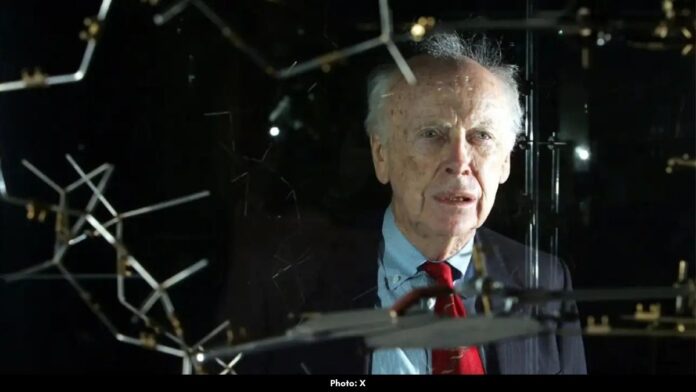

Dr. James D. Watson, the Nobel Prize–winning biologist who co-discovered the double-helix structure of DNA, has died at the age of 97 in East Northport, New York.
According to The New York Times, his son Duncan Watson confirmed the death, saying his father passed away “in hospice care after being transferred there earlier this week from a hospital, where he had been treated for an infection.”
Who Was James Watson?
Born on April 6, 1928, in Chicago, Illinois, James Watson displayed extraordinary academic brilliance from a young age. He earned a zoology degree from the University of Chicago at just 19 and completed his Ph.D. at Indiana University three years later.
At 24, Watson began his groundbreaking research at Cambridge University with Francis Crick. Together, they proposed the famous “double helix” model of DNA in 1953, revealing how genetic information is stored and transmitted in living organisms.
This revolutionary discovery, influenced by Charles Darwin’s theory of evolution, explained the molecular basis of heredity and became a cornerstone of modern biology.
The Nobel Prize and Scientific Impact
Watson and Crick’s model was supported by Maurice Wilkins’s X-ray diffraction data and built upon the pioneering research of Rosalind Franklin. Their combined work was among the most important scientific breakthroughs of the 20th century.
In 1962, Watson, Crick, and Wilkins received the Nobel Prize in Physiology or Medicine for discovering the structure of DNA. The discovery revolutionized genetics, medicine, and biotechnology, leading to advancements in genetic testing, forensic science, and gene therapy.
James Watson’s Family
James Watson married Elizabeth Lewis, a medical student, in 1968. The couple had two sons, Rufus and Duncan Watson.
Throughout his career, Watson remained deeply involved in research and leadership at Cold Spring Harbor Laboratory (CSHL) in New York, where he served as director, president, and later as chancellor.
Controversy and Later Life
Despite his towering scientific influence, Watson’s later years were overshadowed by controversial remarks on race, gender, and intelligence. His statements led to widespread criticism and ostracization within the scientific community.
In 2014, Watson decided to sell his Nobel Prize medal, stating that his remarks had made him an “unperson” and that he faced financial strain after being removed from corporate boards. The medal was sold for $4.8 million to Russian billionaire Alisher Usmanov, who later returned it to Watson in recognition of his contributions to science.
James Watson’s Legacy in Science
Beyond the DNA discovery, Watson was instrumental in the early stages of the Human Genome Project and helped shape Cold Spring Harbor Laboratory into one of the world’s leading genetics research centers.
He was also the author of the acclaimed memoir “The Double Helix”, which provided an insider’s view of the discovery that changed biology forever.
While his later years were marked by controversy, James Watson’s legacy remains inseparable from the discovery that defined modern genetics. His work unlocked the secrets of life’s molecular code and continues to influence scientific progress today.
Key Takeaways
- James Watson (1928–2025), co-discoverer of DNA’s structure, has died at 97.
- Won the 1962 Nobel Prize in Medicine alongside Francis Crick and Maurice Wilkins.
- Married to Elizabeth Lewis Watson; father to Rufus and Duncan.
- His discovery revolutionized genetics, medicine, and biotechnology.