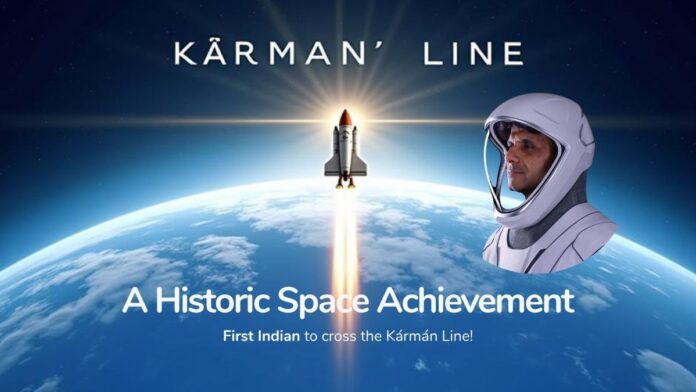

Group Captain Shubhanshu Shukla, an Indian Air Force test pilot turned astronaut, has achieved a milestone by becoming the first Indian to cross the Kármán Line, the internationally recognized boundary of space, aboard the Axiom‑4 (Ax‑4) mission aboard a SpaceX Falcon‑9 rocket on June 25, 2025.
Launched from NASA’s Kennedy Space Center, the privately commissioned two-week mission carries Shukla, mission commander Peggy Whitson, and crew members from Poland and Hungary to the International Space Station (ISS). Upon reaching orbit, Shukla addressed the nation via space-to-ground, declaring: “Namaskar, my dear countrymen!…We are back in space once again after 41 years.” He spoke proudly of the Indian flag on his suit and called the mission a landmark for India’s human spaceflight program.
🚨 𝗜𝗻𝗱𝗶𝗮 𝗵𝗮𝘀 𝗶𝘁𝘀 𝘀𝗲𝗰𝗼𝗻𝗱 𝗮𝘀𝘁𝗿𝗼𝗻𝗮𝘂𝘁 𝗶𝗻 𝘀𝗽𝗮𝗰𝗲 𝗮𝗳𝘁𝗲𝗿 𝟰𝟭 𝘆𝗲𝗮𝗿𝘀!! 👨🚀
Grp. Cpt. Shubhanshu Shukla has officially become the 2nd Indian national to travel to space! 🇮🇳
1. Rakesh Sharma (Soyuz T-11, 1984)
2. Shubhanshu Shukla (Axiom-4, 2025)* pic.twitter.com/HOdSsH4aXi— ISRO Spaceflight (@ISROSpaceflight) June 25, 2025
A Milestone for India’s Space Program
Shukla’s journey ends a 41-year gap since Rakesh Sharma’s historic 1984 spaceflight. Selected as a vyomanaut in 2019, he underwent rigorous training, including at Russia’s Yuri Gagarin Centre and ISRO’s Bangalore facility and holds a M.Tech. in Aerospace Engineering from IISc Bangalore.
The mission coincides with increased NASA‑ISRO collaboration. Shukla will execute seven microgravity experiments, ranging from muscle regeneration and sprout growth to the cultivation of microalgae and studies involving tardigrades, all designed by Indian scientists to support future missions like Gaganyaan.
From Private Launch to Global Impact
The Ax‑4 mission, delayed slightly due to wind and technical checks, lifted off June 25 at 12:01 PM IST using a reused Falcon‑9 rocket and new Dragon capsule. The carefully choreographed 28-hour journey included rocket-stage separation, orbit insertion, ISS rendezvous, docking, and leak checks. Once aboard the ISS, the crew will spend up to 14 days conducting over 60 scientific studies from 31 countries, making it Axiom’s most research-intensive mission yet.
Symbolic and Strategic Significance
Cultural Pride: Shukla carries an insignia designed by Manish Tripathi that blends India’s scientific heritage with modern aspirations, symbolizing the journey from ancient observatories to Gaganyaan-era achievements.
Institutional Support: The Indian Air Force lauded his flight as a “new chapter to Indian space odyssey,” and ISRO personnel were present in Florida to support the mission.
Programmatic Leap: While Gaganyaan remains India’s independently built crewed mission, Ax‑4 bolsters the country’s commercial spaceflight credentials and technological readiness.
Words from the Pilot
Before launch, Shukla expressed gratitude: “Special thanks to family and friends…we do so on the shoulders of so many more…Jai Hind, Jai Bharat.” He credited his wife, dentist Kamna Shukla, and his team’s support on Instagram.
What This Means
Astronaut: Group Captain Shubhanshu Shukla, IAF test pilot
Historic First: First Indian to cross the Kármán Line via Ax‑4
Mission Duration: ~14 days aboard ISS
Research Focus: 7 ISRO-designed microgravity experiments
Strategic Importance: Boosts Gaganyaan readiness and NASA‑ISRO cooperation
This landmark mission marks a major leap forward for India’s human spaceflight ambitions and international collaborations. As the crew continues their research in orbit, the legacy of Shukla’s flight will resonate across educational, technological, and cultural spheres, lighting the path for a new era of Indian exploration.