
A powerful 7.6-magnitude earthquake struck 80km off Japan’s northeast coast late Sunday, sending 40–50cm tsunami waves to shore and prompting evacuation advisories for nearly 90,000 residents. Several injuries have been reported as officials continue to assess the impact.
While tsunami warnings have now been downgraded to advisories, authorities warn that seismic risks remain high.
Aftershocks Recorded as Authorities Warn of Ongoing Instability
Following the initial earthquake, the U.S. Geological Survey (USGS) reported three strong aftershocks, measuring 5.5, 5.0, and 4.8. More tremors may occur in the coming days as Japan continues to experience heightened seismic activity.
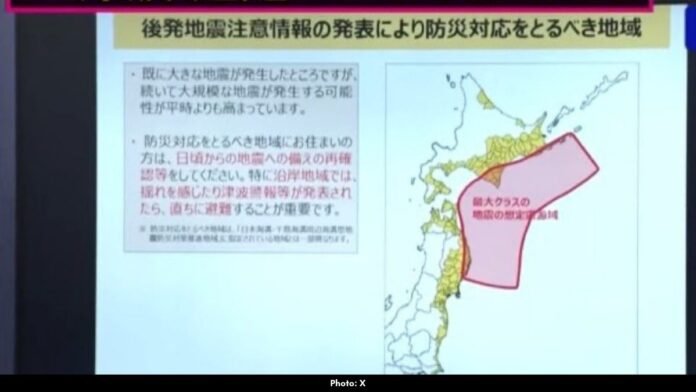
The Japan Meteorological Agency (JMA) has issued a Hokkaido–Sanriku Subsequent Earthquake Advisory, noting that although still unlikely overall, the probability of a large “megaquake” along the Japan Trench is now higher than normal.
🚨🇯🇵Strong Earthquake Japan
A Magnitude 7.6 earthquake recently struck off the coast of Japan triggering Tsunami warnings along the coast.
A Tsunami advisory is now active
Aftershocks are occurring in the area. Residents in coastal areas are advised to move to higher ground. pic.twitter.com/MwKUsiWw4u
— Chyno News (@ChynoNews) December 8, 2025
At Least 13 People Injured, Government Confirms
The Japanese government released its first official injury report following the earthquake and tsunami. According to Disaster Management Minister Jiro Akama, as reported by NHK, 13 people have been confirmed injured so far.
This includes eight with minor injuries, one person seriously injured, and four individuals whose conditions are still being evaluated.
Akama reiterated the prime minister’s call for residents to remain prepared and vigilant over the next week.
Rain-Induced Landslide Risk Elevated After Earthquake
The Japan Meteorological Agency has issued an additional warning highlighting the increased risk of landslides, especially in areas that experienced strong shaking. Because the ground has been weakened, rainfall could trigger hazardous conditions in affected regions.
Local meteorological observatories will now issue heavy rain warnings more frequently, particularly in Aomori Prefecture, with additional high-risk zones in Hokkaido and Iwate.
Prime Minister Urges Preparedness and Caution
Prime Minister Sanae Takaichi posted on X urging residents in strongly affected regions to remain alert throughout the coming week. She advised the public to follow updates from the JMA and local authorities, secure household items, review emergency plans, and be prepared to evacuate if further shaking occurs.
揺れの強かった地域の皆様は、今後1週間程度、気象庁や自治体からの情報にご留意の上、家具の固定など、日頃からの地震の備えの再確認に加え、揺れを感じたらすぐに避難できる態勢を整えていただくようお願いいたします。
地震で負傷された方々に、心からお見舞いを申し上げます。
— 高市早苗 (@takaichi_sanae) December 8, 2025
She also expressed condolences to those injured in the earthquake.
Earthquake Details and Tsunami Impact
The powerful quake struck at 23:15 local time, originating 50km below sea level and roughly 80km off Japan’s northeastern coastline.
Tsunami warnings were issued for three prefectures, triggering widespread evacuation advisories. Waves between 40cm and 50cm reached several coastal communities.
Although the tsunami alert has now been downgraded, officials continue to stress that Japan is not yet in the clear, citing the ongoing risk of aftershocks and potential larger seismic events.