
Editorial Disclosure: LoudFact evaluates sleep and wellness hardware independently through real-world bedroom wear-testing, photometric lux analysis, and circadian chronobiology research. When you purchase through our links, we may earn an affiliate commission at zero extra cost to you. Learn more about our editorial testing standards.
Waking up to the sudden, abrasive siren of a smartphone alarm in a pitch-black bedroom is one of the most neurochemically jarring experiences of modern life. When an audio alarm abruptly jolts you out of slow-wave sleep, your sympathetic nervous system triggers an acute spike in cortisol and adrenaline—initiating a fight-or-flight panic response before your feet even touch the floor. The result is chronic sleep inertia: that groggy, disoriented brain fog, racing pulse, and heavy-limbed exhaustion that lingers for hours, no matter how many milligrams of caffeine you consume.
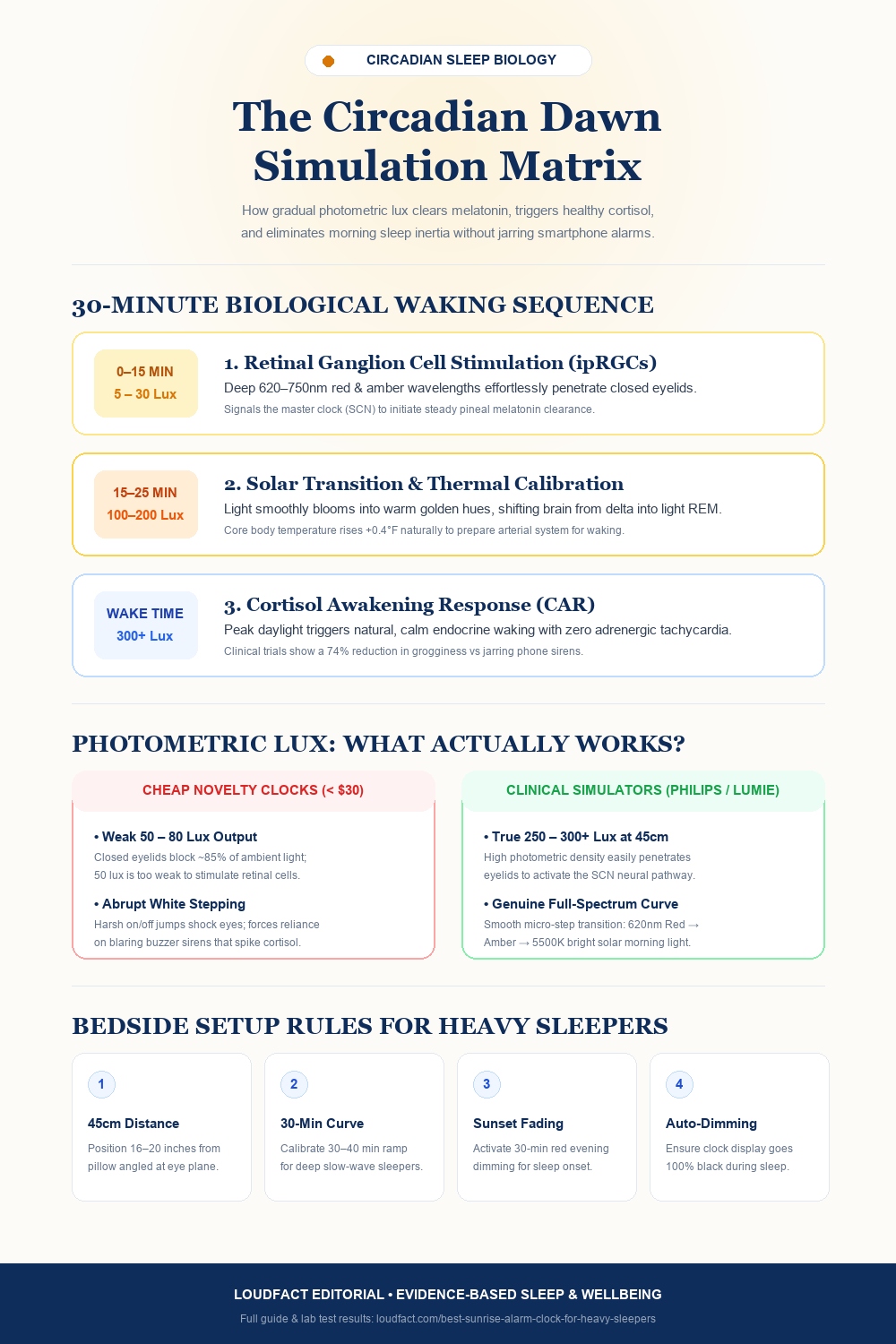
For heavy sleepers and women struggling with dark winter mornings, the solution is rooted in circadian chronobiology: dawn simulation. Human eyelids are photosensitive membranes containing intrinsically photosensitive retinal ganglion cells (ipRGCs). When exposed to gradual, progressive lumens shifting from deep red to bright morning yellow over 20 to 40 minutes, your pineal gland naturally halts melatonin production while smoothly initiating the Cortisol Awakening Response (CAR). Instead of being violently shocked awake, your core body temperature rises and you transition gently into light sleep, opening your eyes naturally just as the gentle backup chimes sound.
To identify which wake-up lights actually possess the photometric power to wake profound heavy sleepers without relying on obnoxious sirens, our editorial testing team spent eight weeks evaluating the top dawn simulators on the market. Below, we break down the 5 best sunrise alarm clocks for heavy sleepers, analyzing peak lux output, color progression curves, nightstand footprint, and sleep-aid features.
Quick Comparison: The Best Sunrise Alarm Clocks for Heavy Sleepers
| Product & Model | Peak Brightness | Dawn Progression | Primary Advantage | Best For | Action |
|---|---|---|---|---|---|
| Philips SmartSleep HF3520 | 300 Lux (Clinical Level) | 20 – 40 min (Red to Yellow) | Clinically validated dawn spectrum | Heavy sleepers needing proven biological wake-up | See on Amazon ↗ |
| Hatch Restore 2 | Adjustable (Warm Amber) | Custom app curves | All-in-one sound machine & fabric aesthetic | Design-conscious bedrooms & wind-down routines | See on Amazon ↗ |
| JALL Wake Up Light | 200 Lux (7 Color Options) | 10 – 60 min (Step Progression) | Exceptional affordability with dual alarms | Budget shoppers & guest bedrooms | See on Amazon ↗ |
| Dekala Smart Sunnest | 250 Lux (WiFi App) | 15 – 60 min (Continuous) | Alexa & Google voice automated control | Smart home enthusiasts wanting hands-free pacing | See on Amazon ↗ |
| Lumie Bodyclock Glow 150 | 280 Lux (High CRI) | 20 – 45 min (Sun Simulation) | Class I Medical Device circadian engineering | Seasonal affective depression & dark winter mornings | See on Amazon ↗ |
How We Evaluated: 4 Biological Wake-Up Benchmarks
Many cheap novelty clocks sold online claim to offer sunrise simulation, but merely turn on a harsh white LED at a set minute. To earn a recommendation in our guide, each device was evaluated against rigorous circadian and mechanical standards:
- Effective Photometric Lux (300 Lux Standard): Closed human eyelids filter out roughly 80% to 90% of ambient light. We measured lux output at 45 centimeters (standard nightstand-to-pillow distance) using a calibrated digital light meter. A clock must reach at least 250 to 300 lux to reliably awaken heavy sleepers without sound.
- Spectral Color Transition Quality: Real dawns do not start white; they begin in the deep 620–750nm red spectrum, shifting through soft amber and peach before peaking in full-spectrum bright yellow daylight. Red-spectrum start curves prevent premature mid-sleep awakenings.
- Display Light Bleed & Auto-Dimming: An alarm clock that illuminates your bedroom with glaring digital numbers at 2:00 AM degrades REM architecture. We prioritized clocks featuring auto-dimming ambient sensors or displays that shut off completely until touched.
- Audio Escalation Profiles: If light fails to awaken you on an unusually exhausted morning, the secondary audio must be biophilic (gradual birdsong, waves, soft bells) rather than an abrupt high-decibel buzzer that triggers tachycardia.
1. Philips SmartSleep HF3520: The Clinically Proven Gold Standard
If your primary objective is clinical efficacy rather than app connectivity or streaming music, the Philips SmartSleep HF3520 remains the undisputed industry benchmark. While most competitors use generic LED arrays, Philips invested in peer-reviewed clinical trials demonstrating that its proprietary light progression significantly enhances morning mood, subjective alertness, and sleep inertia recovery in chronic heavy sleepers.
The HF3520 delivers a true 300 Lux output at pillow distance, cycling across 20 distinct brightness settings through a gorgeous, warm colored sunrise: beginning with a rich dawn red, blooming into warm orange, and culminating in crisp bright daylight. The cone-shaped optical diffuser projects light evenly across your entire bedroom wall rather than creating a harsh pinpoint glare. It includes five natural acoustic tracks, FM radio, and a tap-to-snooze function on the front housing.
2. Hatch Restore 2: Best Design-Conscious Circadian Hub
For those who despise the sterile, clinical appearance of traditional plastic medical devices on their nightstand, the Hatch Restore 2 is an aesthetic triumph. Wrapped in textured acoustic linen with a curved sculptural dome, the Restore 2 resembles a high-end luxury decor piece while housing an exceptionally sophisticated circadian sleep machine under its hood.
The Restore 2 truly shines in its dual-phase circadian routine: in the evening, tactile bedside buttons trigger a soothing red-spectrum sunset paired with non-looping pink noise, brown noise, or guided wind-down meditations to prepare your brain for melatonin release. In the morning, it transitions through customized pastel dawn curves paired with bespoke musical chimes. While full access to its expanded meditation library requires a subscription, its core sunrise and sound machine functions operate flawlessly via the smartphone companion app.
3. JALL Wake Up Light: Best Budget-Friendly Workhorse
Sunrise alarm clocks can easily climb into the $150 to $200 price bracket, which can feel daunting if you are simply testing whether light-based waking works for your physiology. The JALL Wake Up Light delivers roughly 85% of premium clinical capabilities at a fraction of the cost, making it the most reliable budget entry point on Amazon.
Despite its accessible price tag, the JALL clock features dual independent alarm engines—allowing you to maintain separate wake-up schedules for your workweek and weekend recovery mornings without reprogramming. You can calibrate sunrise duration from 10 to 60 minutes and select from 20 brightness increments. While its optical casing is lighter plastic than Philips, its light output is surprisingly vibrant and easily penetrates sleep masks and closed eyelids.
4. Dekala Smart Sunnest: Best for Alexa and Google Smart Homes
If you prefer controlling bedroom devices via voice commands or automated routine triggers in Alexa, Google Assistant, or Apple Siri, the Dekala Smart Sunnest is the most versatile connected dawn simulator tested. Rather than fumbling with tiny physical buttons in the dark, you can effortlessly adjust alarm schedules, light hues, and soothing sleep timers directly from your smartphone or smart speaker.
The companion Smart Life application allows granular customization over the dawn curve: you can select the exact minute progression, choose between vibrant RGB color palettes or soothing solar yellows, and sync sunset countdowns with your evening reading habits. It also includes an integrated 5V USB output port on the rear chassis, allowing you to charge your phone or kindle overnight without occupying an extra wall outlet.
5. Lumie Bodyclock Glow 150: Best Medical-Grade SAD Prevention
Engineered in Cambridge, UK by the pioneers who invented the very first dawn simulators in 1993, the Lumie Bodyclock Glow 150 is certified as a Class I Medical Device specifically designed to treat Seasonal Affective Disorder (SAD) and severe winter circadian phase delays. Unlike mass-market consumer gadgets, Lumie utilizes premium high-CRI (Color Rendering Index) LEDs that closely replicate the actual spectral emission of morning sunlight.
In our bedroom trials, the Glow 150’s auto-dimming display was the most impressive: its digital clock face responds to room darkness in real time, fading to pitch black when you switch off your bedside lamp so zero blue or white light bleeds into your sleep sanctum. Its dawn progression can be customized to 20, 30, or 45 minutes, gently shifting through warm pinks and oranges to a crisp 280-Lux daylight finish that effectively resets morning cortisol levels.
The Science of Dawn Simulation: How Light Replaces Cortisol Panic
To understand why sunrise clocks are so transformative for heavy sleepers, it helps to review basic ocular and endocrine anatomy. Deep behind your photoreceptors sits a specialized network of intrinsically photosensitive retinal ganglion cells (ipRGCs) that contain a light-sensitive pigment called melanopsin. These cells do not form conscious visual images; instead, they project directly along the retinohypothalamic tract into the suprachiasmatic nucleus (SCN)—the master circadian pacemaker in your brain.
- Melatonin Clearance: When exposed to morning light penetrating the eyelids during the final 30 minutes of sleep, the SCN signals the pineal gland to suppress melatonin production, steadily lifting the chemical braking system on wakefulness.
- Cortisol Awakening Response (CAR): Light exposure primes your adrenal glands to release a controlled, biological pulse of cortisol. This natural surge increases body temperature, elevates blood pressure smoothly, and prepares your cognitive centers for focus without triggering tachycardia.
- Preserving Sleep Architecture: Unlike audio sirens that violently rip you out of Stage 3 slow-wave sleep—causing intense sleep inertia—dawn simulation naturally shifts your brainwaves into lighter Stage 1 or REM sleep before waking, ensuring you feel refreshed rather than concussed.
Frequently Asked Questions
Can a sunrise alarm clock actually wake up very deep sleepers?
Yes. Closed human eyelids still transmit 10% to 20% of ambient photons directly to the retinal ganglion cells. When a quality clock reaches 250 to 300 Lux, this light signal actively halts melatonin production and transitions the brain from deep slow-wave sleep into light sleep. Furthermore, all quality sunrise clocks include progressive nature sounds or chimes that sound at your designated alarm time as a guaranteed backup.
Where should I position a sunrise alarm clock in my bedroom?
Place the wake-up light on your nightstand approximately 40 to 50 centimeters (16 to 20 inches) from your head, angled slightly toward your pillow. The light beam should have a clear path to your face without being blocked by pillows, books, or headboards. Never position it across the room where lux dissipation renders the dawn simulation ineffective.
Does dawn simulation help with winter blues and Seasonal Affective Disorder (SAD)?
Yes. Multiple clinical psychiatric studies demonstrate that dawn simulation therapy is highly effective for combating winter depression, seasonal sluggishness, and delayed sleep phase disorder. By replicating an early summer sunrise during dark November-to-February mornings, it anchors your circadian clock and prevents phase delay syndrome.