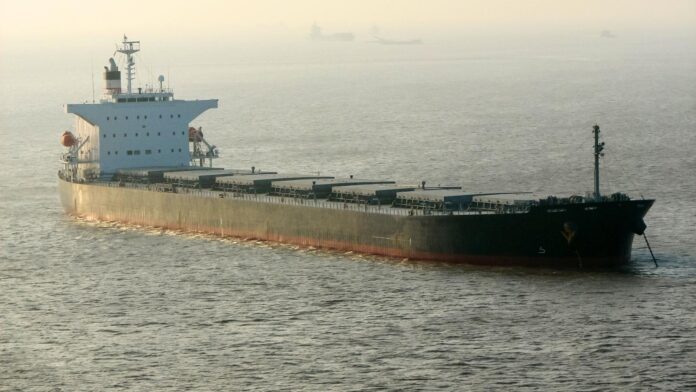

The US naval blockade of Iranian ports entered its second full day on Tuesday amid a sharp escalation in Iranian rhetoric and domestic protests. In Tehran, thousands of Iranians took to the streets in demonstrations against what their government has called an American siege. Iran’s armed forces issued their most explicit threat yet toward other regional ports. And Hormuz shipping data showed a near-total standstill.
Iran’s Official Position
Iran’s armed forces accused the US of “piracy” ahead of the planned blockade. A statement carried by the semi-official Iranian Student News Agency read: “The criminal actions of America in restricting maritime transit in international waters are illegal and constitute piracy.”
The statement continued: “The Armed Forces of the Islamic Republic of Iran clearly and firmly declare that security of ports in the Persian Gulf and the Sea of Oman is either for everyone or for no one.”
Iran added that if the security of its ports “is threatened, no port in the Persian Gulf and Sea of Oman will remain safe” — a direct threat against the ports of Saudi Arabia, the UAE, Qatar, Kuwait, Bahrain and Iraq, through which a significant share of the world’s energy exports pass.
Thousands Rally in Tehran
Iran accused the US of committing piracy as thousands of Iranians rallied in Tehran against the blockade in the Strait of Hormuz. State television broadcast the demonstrations and senior officials addressed crowds. The protests combined nationalist anger at the blockade with the broader sentiment of resistance that Iranian state media has cultivated since the war began on February 28.
What the Blockade Is Actually Doing to Shipping
Little traffic is entering and leaving Iranian ports in the Persian Gulf and the Gulf of Oman on the first full day of the US blockade, according to ship-tracking data.
The blockade began at 14:00 GMT on Monday. Even though Iran has become accustomed to US sanctions and has continued to function during the war, a blockade like this could inflict significant damage to Iran’s economy, analysts said.
Iran’s oil exports through the Strait of Hormuz account for about 80 percent of its total exports. According to trade intelligence firm Kpler, Iran exported 1.84 million barrels per day of crude oil in March — exports that are now the direct target of the blockade.
At least three tankers have entered the Gulf via the Strait of Hormuz on Tuesday, shipping data from LSEG and Kpler shows — a fraction of the 130 daily transits that occurred before the war began.
Iran’s Economic Escape Routes Are Limited
Besides oil, the US blockade of Iranian ports could also impact Tehran’s trade of other goods. Some key exports include petrochemicals, plastics and agricultural products, while major imports include industrial machinery, electronics and food, primarily sourced from China, the UAE and Turkey.
A blockade that disrupts non-hydrocarbon trade will not only be a blow to revenues but also to supplies, leading to increased domestic shortages in an economy already under strain from pre-war sanctions.
Iran’s potential escape routes — overland rail to China, ghost ships with transponders switched off — are logistically limited. There is currently no credible evidence that oil has been transported by rail from Iran to China at meaningful scale, and transporting hydrocarbons by rail involves considerable logistical challenges.
How Other Countries Are Responding
China’s Foreign Ministry criticised the blockade plan. “The Strait of Hormuz is an important international trade route for goods and energy, and maintaining its security, stability and unimpeded flow is in the common interest of the international community,” Foreign Ministry spokesman Guo Jiakun said, urging Iran and the US not to reignite the war.
British Prime Minister Keir Starmer said the UK is “not supporting a blockade” of Iran’s ports. “It is, in my view, vital that we get the strait open and fully open,” he told BBC Radio 5 Live, adding that the focus should be on reopening Hormuz rather than enforcing port restrictions.
The ceasefire that paused six weeks of war expires April 22. The blockade has been in effect for less than 48 hours. And Iran’s threat to make every Gulf port unsafe — if aimed credibly at Saudi and Emirati facilities — would constitute one of the most significant escalations of the entire conflict.