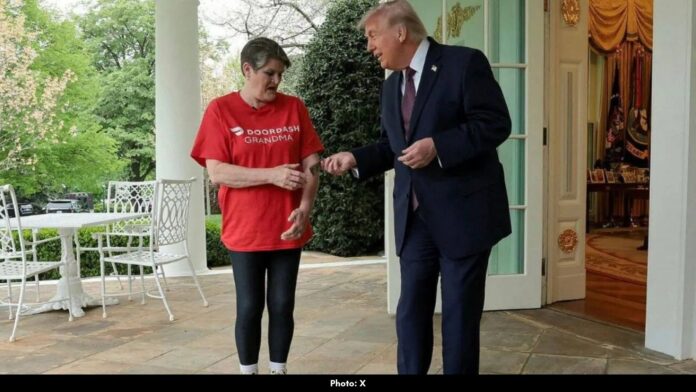

A routine food delivery turned into a viral national story after Sharon Simmons—quickly dubbed the “DoorDash Grandma” online—delivered a McDonald’s order to former US President Donald Trump at the White House.
The moment, which unfolded earlier this week, gained widespread attention across social media and news platforms. Images and clips of the interaction—featuring a delivery driver in a red “DoorDash Grandma” t-shirt handing over fast food at one of the most secure addresses in the world—quickly captured public interest.
But beyond the viral appeal, the story also intersected with broader themes: the gig economy, tipping culture, and political messaging.
WATCH IN FULL: @POTUS receives a @DoorDash delivery to the Oval Office.
“I have your @DoorDash order for you, Mr. President!” pic.twitter.com/lwFHbHmYVk
— Rapid Response 47 (@RapidResponse47) April 13, 2026
What Happened
According to available reports, Sharon Simmons, a full-time DoorDash driver from Arkansas, delivered two bags of McDonald’s—containing cheeseburgers and fries—to the White House.
The delivery reportedly took place outside the West Wing, along the colonnade area, where Simmons handed over the order directly.
Key details from the interaction include:
- Simmons was invited to deliver the order as part of a planned moment
- She wore a red t-shirt labeled “DoorDash Grandma”
- After the delivery, she received a $100 tip
- She was later invited inside for a tour of the Oval Office
The food was subsequently shared among White House staff, according to official accounts.
The unusual nature of the delivery—combined with the location and the individuals involved—helped propel the story into viral territory.
President Trump just received a McDonald’s delivery order from a DoorDash driver outside the Oval Office!
Thanks to President Trump signing No Tax on Tips into law, Sharron is using the $11,000 in tips that she made last year to support her family.
💰 🚗 🍔 🍟 pic.twitter.com/5JkpJo839k
— Karoline Leavitt (@PressSec) April 13, 2026
Who Is Sharon Simmons
Sharon Simmons is a grandmother of 10 from Arkansas who has been working as a DoorDash driver since 2022.
Her profile reflects a broader segment of the US workforce engaged in gig-based employment.
Key background details include:
- Full-time DoorDash driver
- Over 14,000 deliveries completed
- Relies significantly on tips as part of her income
- Primary earner in her household
Her personal circumstances have also been part of the story’s visibility.
Reports indicate that her husband has been undergoing treatment for cancer, leading to reduced household income. As a result, Simmons has taken on a larger financial role, with delivery work and tips helping to cover:
- Medical expenses
- Household costs
- Travel to visit family
This context has contributed to the emotional resonance of the story, particularly in discussions around the gig economy.
Why the Story Went Viral
Several factors helped the story gain rapid traction.
1. Unusual Setting
Food deliveries to the White House are rare, and the image of a gig worker entering such a high-security environment immediately drew attention.
2. Human Interest Angle
Simmons’ background—as a grandmother supporting her family—added a relatable and emotional dimension.
3. Visual Simplicity
The imagery was straightforward and compelling:
- A delivery driver
- A fast food order
- A historic location
This combination made the story easy to share and understand.
4. Timing
The moment occurred close to Tax Day in the United States, adding relevance to discussions around income and taxation.
The Policy Context Behind the Moment
While the story initially appeared to be a lighthearted human-interest moment, it was also tied to a broader policy narrative.
During the interaction, Trump referenced his administration’s “no tax on tips” initiative, using Simmons’ experience as an example.
Key elements of the policy include:
- Exempting a portion of tipped income from federal taxation
- Eligibility thresholds based on annual income
- Continued application of payroll taxes
Under the proposal, individuals earning below a certain threshold could exclude up to a specified amount of tip income from taxation.
Simmons’ Experience With Tipping Income
Simmons reportedly told the president that the policy had helped her family significantly.
According to her account:
- Tips make up a substantial portion of her income
- She earned approximately $11,000 in tips in the previous year
- Tax-related savings had a noticeable financial impact
Her experience was presented as an example of how policy changes can affect individuals working in service-based roles.
Separating Symbolism From Reality
While the story has been widely shared, it is important to distinguish between:
- The confirmed facts of the event
- The broader narrative built around it
Confirmed elements:
- A DoorDash delivery was made to the White House
- Sharon Simmons is a real delivery driver with the described background
- She received a tip and was invited inside
Contextual considerations:
- The delivery appears to have been arranged rather than random
- The moment was used to highlight a specific policy message
- The event carries both symbolic and practical elements
The Gig Economy in Focus
The story has also drawn attention to the realities of gig work in the United States.
Platforms like DoorDash operate on a model where:
- Workers are classified as independent contractors
- Income can vary significantly
- Tips play a major role in earnings
For many workers, including Simmons, tipping is not just a bonus—it is a core component of income.
Why Tipping Remains a Key Issue
Tipping in the US has long been a subject of debate.
Supporters argue:
- It allows workers to earn more
- It rewards service quality
Critics argue:
- It creates income instability
- It shifts responsibility from employers to customers
Policies affecting tipped income therefore have broader implications for millions of workers.
Public Reaction
Online reactions to the story have been mixed.
Positive responses:
- Appreciation for the human-interest aspect
- Recognition of gig workers’ contributions
- Support for policies benefiting service workers
Critical responses:
- Questions about the staging of the event
- Debate over the policy implications
- Concerns about political messaging
A Moment That Blends Reality and Narrative
The “DoorDash Grandma” story sits at the intersection of:
- Real-life experience
- Media amplification
- Policy messaging
It reflects how individual stories can be used to illustrate broader themes, particularly in areas such as:
- Economic policy
- Labor conditions
- Social narratives
What This Story Represents
At its core, the story highlights several broader trends:
1. The Visibility of Gig Workers
Gig economy workers are increasingly central to daily life, yet their stories often receive limited attention.
2. The Power of Viral Moments
Simple, relatable stories can quickly gain national and global attention.
3. The Intersection of Policy and Personal Experience
Individual experiences are often used to illustrate the impact of policy decisions.
Conclusion
Sharon Simmons, the “DoorDash Grandma,” became the focus of a viral story after delivering McDonald’s to the White House—a moment that combined human interest, political messaging, and social media amplification.
While the core events are supported by available reports, the broader narrative reflects a mix of:
- Genuine personal experience
- Symbolic storytelling
- Policy-driven framing
As with many viral stories, understanding the full context is essential.
In this case, the delivery itself may have lasted only minutes—but its impact, both online and in public discussion, has extended much further.