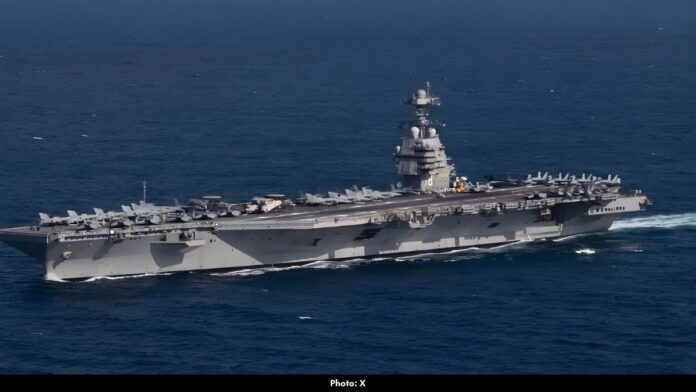

The USS Gerald R Ford, the most advanced aircraft carrier in the U.S. fleet, entered the Caribbean Sea on Sunday as part of a major military buildup under Operation Southern Spear. The deployment marks one of the largest U.S. naval movements in the region in decades, adding significant firepower to ongoing maritime strikes targeting boats the U.S. accuses of transporting drugs.
According to the Navy, the mission now includes nearly a dozen warships and about 12,000 sailors and Marines.
Why the U.S. Deployed the USS Gerald R Ford
U.S. military officials say the carrier strike group is intended to reinforce counterdrug operations across the Caribbean. Rear Adm. Paul Lanzilotta said the group aims to protect national security and respond to narco-terrorism threats, while Adm. Alvin Holsey emphasized that the buildup strengthens efforts to secure the Western Hemisphere.
The strike group sailed through the Anegada Passage near the British Virgin Islands before entering the Caribbean Sea. Its arrival “rounds off” one of the largest U.S. military displays in Latin America in a generation.
U.S. forces have already carried out at least 20 strikes since early September on small boats accused of drug trafficking, with more than 80 people killed, according to an AP report.
Regional Reactions: Allies and Opponents Split
Trinidad and Tobago Joins U.S. Training Exercises
Officials in Trinidad and Tobago, located just seven miles from Venezuela, confirmed that joint military exercises with U.S. troops began over the weekend. Foreign Minister Sean Sobers said the training targets violent crime and drug trafficking on the island nation. Marines from the 22nd Expeditionary Unit are participating after months stationed on ships near Venezuela.
Venezuela Calls U.S. Presence an “Act of Aggression”
Venezuela’s government condemned the exercises but did not immediately comment on the arrival of the USS Gerald R Ford. Venezuelan officials recently announced a “massive mobilization” of troops and civilians in preparation for potential U.S. action.
President Nicolás Maduro wrote: “The Venezuelan people are ready to defend their homeland against any criminal aggression.”
What Is Driving Rising Tensions With Venezuela?
U.S. officials claim the buildup is aimed at stopping drug trafficking but have provided no evidence that those killed in boat strikes were “narcoterrorists.”
Former President Trump has said the U.S. is in “armed conflict” with drug cartels and hinted operations could expand to intercept drugs coming by land.
Washington Rejects Maduro’s Leadership
Secretary of State Marco Rubio said the U.S. views Venezuela’s government as a “transshipment organization” tied to drug trafficking. Maduro denies the accusations and accuses Washington of fabricating a pretext for military escalation.
Is the U.S. Preparing for Larger Military Action?
Analysts are divided. While aircraft carriers typically deter hostile governments and enable deep-strike capability, some argue the USS Gerald R Ford is not optimized for anti-cartel operations — suggesting its presence is a political signal rather than a tactical necessity.
Washington lawmakers have demanded more information about the strikes and legal justifications. Recent attempts to restrict the President’s ability to take military action against Venezuela without congressional approval were blocked by Senate Republicans.
A Show of Force That Resonates Across Latin America
The USS Gerald R Ford’s arrival is viewed as a defining moment in U.S. military posture in the region.
Elizabeth Dickinson of the International Crisis Group said: “This is the anchor of what it means to have U.S. military power once again in Latin America. And it has raised a lot of anxieties in Venezuela but also throughout the region.”
With tensions rising and U.S. forces expanding operations on land and sea, regional governments are watching closely to see how far the U.S. is willing to go.