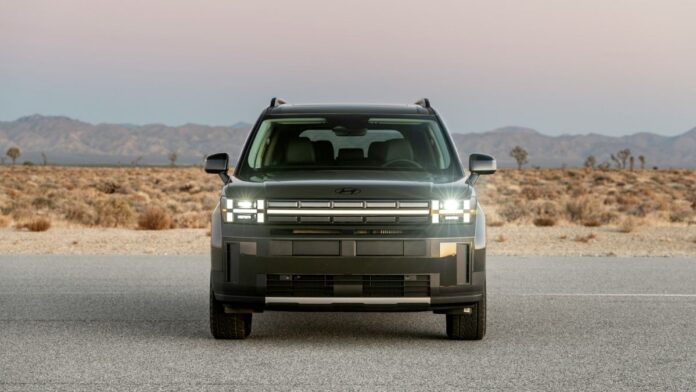

Hyundai has announced a major recall of 135,386 Santa Fe SUVs built between December 28, 2023, and July 7, 2025, following the discovery of a potential fire risk linked to the starter motor assembly.
The recall affects 2024 and 2025 Santa Fe models equipped with the 2.5-liter turbocharged gasoline engine. According to the company, the B+ terminal cover on the starter motor might not have been installed correctly, increasing the risk of an electrical short in certain crash situations.
Problem Discovered During Safety Testing
The National Highway Traffic Safety Administration (NHTSA) revealed that the issue surfaced during NCAP frontal crash tests. Engineers noticed smoke coming from the engine compartment.
Hyundai later reproduced the problem under controlled conditions, confirming that contact between the exposed terminal and the cooling fan could cause an electrical short — and in extreme cases, a fire.
“No field incidents, crashes, injuries, or fatalities have been reported so far,” Hyundai stated.
Free Dealer Repairs and Owner Guidance
All Hyundai dealers will inspect and reinstall the starter motor terminal cover at no charge. Notification letters to owners are expected to go out starting December 1.
Owners can reach Hyundai Customer Care at 855-371-9460 (recall number 285) or verify their vehicle’s VIN on the NHTSA recall website.
Hyundai urged customers to take the recall seriously to reduce any potential safety risks.
Automakers Face Busy Year of Safety Recalls
This recall joins a growing list of 2025 vehicle safety actions across the industry. Ford has already recorded a record number of recalls, while Nissan, BMW, and Chevrolet have also flagged fire-risk issues in multiple models.
Hyundai has dealt with several safety campaigns this year, including a seatbelt recall for over 568,000 Palisade SUVs and smaller fire-risk recalls for the Palisade and Ioniq 5 N models.
Safety experts continue to emphasize that while recalls may seem inconvenient, they play a crucial role in preventing on-road hazards and maintaining public trust in vehicle safety.